


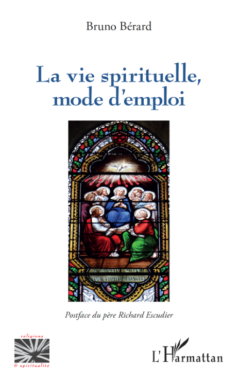
What is the spiritual life? And how does one enter into it?
Born of a question asked long ago—“What is the spiritual life?”—this book offers less a theoretical answer than an invitation to experience it.
Through fifty short reflections, The Spiritual Life: A User’s Guide leads the reader gradually from an awareness of the human condition to an openness to the spiritual world, and from there to contemplation, prayer, and inner transformation. It explores silence and presence, knowledge and love, self-emptying and forgiveness, grace and freedom, culminating in the ultimate calling of the spiritual life: to allow the Spirit to transform our very being.
Drawing on the great masters of the Christian tradition—Dionysius the Areopagite, Saint Augustine, Meister Eckhart, Saint Thomas Aquinas, and Saint John of the Cross—as well as more recent spiritual teachers such as Pamphile, Abbé Henri Stéphane, François Chenique, and Jean Borella, the book offers neither a system nor a ready-made method. Each reflection can be read independently, as a doorway into the inner life.
A simple yet demanding journey, from reflection to contemplation, from knowledge to union, leading us to discover that the spiritual life is not so much something we do as a life we learn to receive.
Contents
Foreword
A Foretaste
Context — Divine Signs and Human Freedom
The Spiritual Life — From the Sacred to the Spirit
A User’s Guide — An Overview
A User’s Guide — Contemplating the Mysteries
A User’s Guide — The Proposed Path
The Spiritual Life — Perspectives
Conclusion — Toward an Entry into the Spiritual Life
Afterword by Father Richard Escudier
Index
Excerpt
The Spirit in Man
In the human being, spirit refers to the highest dimension of the soul. It is not something material, but an inner faculty that gives access to reality in its truth.
Philosophers have described this faculty in different ways. For Aristotle, it is the intellect, capable of knowing reality. For Plato, it is oriented toward truth and the Good. Plotinus sees it as a link between man and the intelligible world.
Spirit is also related to the will: it enables us not only to know, but also to will the good, as Saint Thomas Aquinas explains.
The human being may thus be understood as comprising three dimensions: body, soul (or psyche), and spirit.
Spirit is that which opens man to something greater than himself.
The Spirit in God
When Christianity affirms that “God is Spirit” (Jn 4:24), it is not speaking of an abstraction, but of a living reality: absolute intelligence and love.
In the Trinity, God is one, yet exists in three Persons: the Father, the Son, and the Holy Spirit. These Persons are not separate individuals, but living relations.
The Father is the relation of paternity, the Son the relation of filiation, and the Holy Spirit the relation of love. In this understanding, the relations are not secondary: they constitute what the Persons themselves are.
To the Spirit are attributed in particular the principle of life, spiritual intelligence, and the power to sanctify.
Saint Augustine expresses this idea strikingly:
“The Spirit is the Spirit of the Father and of the Son, and ours.”
De Trinitate, Book XV, ch. 19, § 37, PL 42, col. 1090
This means that the Spirit is not only in God: He is also communicated to man as a gift. Through this gift, man can participate in the divine life.
It is this participation in the Spirit that we call the spiritual life.
Reviews
What is the spiritual life? Is there a user’s guide?
This book is neither a theological treatise nor a manual of spiritual recipes. More modestly, it is the sharing of an experience, nourished by a number of contemporary masters—Pamphile, Jean Borella, François Chenique, Abbé Henri Stéphane…—and by others from earlier times: St Dionysius the Areopagite, Meister Eckhart, St Teresa of Ávila, St John of the Cross, and many more.
Through fifty short reflections, each of which can be approached independently, a path gradually takes shape: that of a life in the Spirit, in which prayer, knowledge, and love lead to an inner transformation.
For, in the words of St Augustine, “the Spirit is the Spirit of the Father and of the Son, and ours.”

