


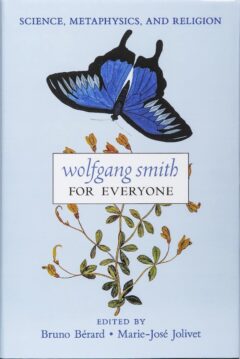
This book was originally planned as a tribute to Wolfgang Smith on the occasion of his 95th birthday; published posthumously, it remains a heartfelt homage, combined with an introduction to his work—that is to say, above all, to physical science freed from scientism.
That Wolfgang Smith was at once a mathematician, a physicist, and a metaphysician is rare enough to be noted from the outset. Certainly, there were Plato, Aristotle, Descartes, Leibniz… but in an age of hyper-specialization in the sciences, a transversal mode of thinking is all the more welcome and invaluable.
While one of the characteristics of Wolfgang’s writings is their clarity and precision—“to the point,” as one would say in English—it may seem surprising to attempt a global introduction. Yet, as will become apparent, surveying the wide range of topics he addressed—quantum physics, perception, cosmology, evolutionism, Teilhardianism—was far from useless. What emerges is a coherent vision, a Weltanschauung, a worldview capable not only of offering physics a way out of its current impasse, but above all of providing an understanding of the world and of man under the gaze of an irrefutable transcendence.
The aim here was certainly not to develop a full-fledged thesis on the life and work of Wolfgang Smith; rather, the following chapters are meant to offer an overview and facilitate comprehension—while consistently referring the reader to the master’s own books.
Fifteen contributors agreed to produce this presentation of a remarkable body of work, which stands as a genuine tribute to Wolfgang Smith.
Contents
Introduction: Wolfgang Smith and Initiation
Tributes & Homages
Part I – Personal Elements
I. Significant Biographical Elements
II. Essential Bibliography
Part II – Physics and Metaphysics. Materia
III. On Metaphysics in Physics
IV. The Philosophy of Physics of Wolfgang Smith: A Personal Reflection
V. The Metaphysics of the Measurement Problem
VI. Measuring Things
VII. Interpreting Quantum Mechanics: Descending or Ascending Ontology?
VIII. Newtonian and Aristotelian Physics: Wolfgang Smith’s Path Toward Reconciliation
IX. Restoring an Integral Ontology: Wolfgang Smith on the Limits of Scientism
Part III – Physics and Metaphysics. Cosmologia
X. Restored Foundations
XI. Reflections on Wolfgang Smith’s Platonic Cosmology
Part IV – Science, Metaphysics, and Religion
XII. A Response to Wolfgang Smith
XIII. Wolfgang Smith, Traditionalist Catholic
XIV. Against Teilhardian Science-Fiction Theology
XV. Putting an End to Evolutionism
Conclusion:
XVI. The End of Quantum Reality: A Conversation with Wolfgang Smith
Contributors
Index of Names
Excerpt
Some readers will not be surprised to learn that Wolfgang Smith’s philosophy of physics is deeply Thomistic and Platonic. Indeed, what individualizes objects in the corporeal world are their substantial forms (Thomistic) — the ontological principles that choreograph matter (potentiality) into specific entities. More poetically, a substantial form is that principle of actuality which makes, for example, a soaring eagle different from a gust of wind, or which makes a human being more than flesh and bones, but a rational animal capable of love.
The kind of causality affirmed by the exercise of substantial forms is also fundamentally different from the causality encountered in physics. Whereas in physics, causality operates within time and space through a sequence of events, substantial form exerts causality outside of time and space, with no physical chain of events. Smith speaks of horizontal causality (HC) for the former, and vertical causality (VC) for the latter.
Since his early work The Quantum Enigma, VC has played a crucial role in Wolfgang Smith’s construction of an ontology of science. Yet it is only in one of his final writings that he provided a definitive exposition of the origin of VC.
— John Taylor, from Chapter IV: “The Philosophy of Physics of Wolfgang Smith: A Personal Reflection”
Notice of publication
Few thinkers of the modern era have ranged as widely—or seen as deeply—as Wolfgang Smith.
Mathematician, physicist, philosopher, metaphysician, and devoted Christian, Smith spent a lifetime challenging the assumptions that have shaped modern thought. Drawing upon both the rigor of contemporary science and the perennial wisdom of the great philosophical and religious traditions, he developed a remarkably integrative vision and opened new paths of inquiry into the nature of reality, consciousness, cosmology, and the human person. His pioneering work on the foundations of physics, culminating in his doctrine of vertical causality, offered a profound alternative to the reductionist worldview that has dominated the modern age and established him as one of the most original and far-reaching thinkers of our time.
Conceived as a tribute to Wolfgang Smith on the occasion of his ninety-fifth birthday, this volume assembles friends, colleagues, students, translators, publishers, and fellow scholars to share personal recollections of the man behind the books—his generosity, humility, faith, intellectual courage, and unwavering devotion to truth. Interwoven with these personal tributes are accessible introductions to the major themes of Smith’s work: quantum physics, cosmology, metaphysics, scientism, evolution, Christian wisdom, and the recovery of a meaningful and intelligible universe. Together they provide an ideal gateway into a body of thought that has influenced philosophers, theologians, scientists, artists, and seekers around the world.

