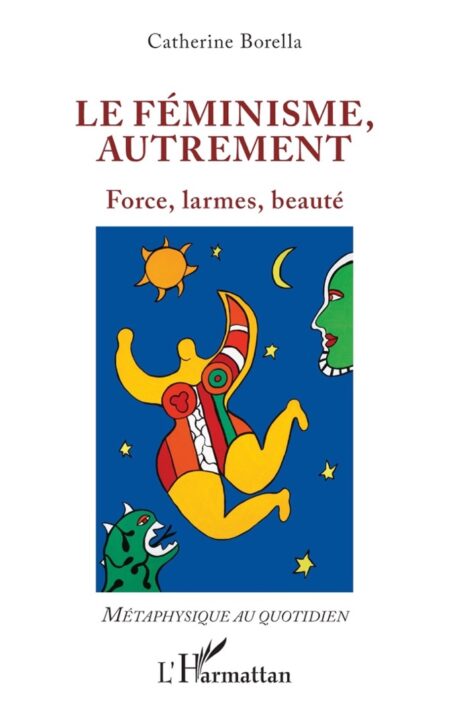
Catherine Borella, Félinisme, autrement. Force, Larmes, Beauté (“Feminism, Otherwise: Strength, Tears, Beauty”), L’Harmattan, 2026, 126 pp., €14.
Can we conceive a feminism that is neither ideological nor merely reactive?
An unexpected reading! In just a few pages, we encounter a rediscovered feminism—from ecofeminism to Plato, from Virginia Woolf to Simone Weil—culminating in a renewed understanding of the feminine as a power of truth.
This is precisely the book’s wager: from the lived body in Maurice Merleau-Ponty to the figure of Diotima in Plato, it seeks to uncover a metaphysics of the feminine that has largely gone unnoticed.
This book is a journey into the ontology of woman, a voyage across the vast sea of her identity. We move from dangerous rocks to peaceful islands, from storms to bursts of sunlight, from damages once thought irreversible to royal roads where men and women finally navigate together—for their mutual good.
Let us see what this means.
Ecofeminism: Ending the Exploitation of the Living
We must begin by noting that ecofeminism permeates these pages, with Françoise d’Eaubonne never far away. The book shows how women’s way of being-in-the-world entails a particular respect for, and knowledge of, the living—its vulnerability, the conditions of its growth, its beauty. Ecofeminism calls us to renounce the project of controlling and exploiting nature articulated by Francis Bacon in the 17th century, at the birth of modern science: “Nature is a common woman; she must be subdued, bound to our desires, and her secrets penetrated.” Behind this fantasy of violation lies a deep impulse to exploit the living world—an impulse whose consequences we now suffer. This is what the book brings to light.
Ecofeminism as Metaphysics
What interests us here—and what ecofeminism does not yet fully realize—is that it has a metaphysical dimension.
To be is to be in the world through the body that I am, as Maurice Merleau-Ponty shows. In the female body is inscribed, of course, the capacity to give birth. Yet this book avoids any moralizing confinement that would reduce women to limiting social roles: the issue is less biological capacity than existential, psychic, symbolic, and spiritual potential. This is precisely what Plato shows in The Symposium through the immortal figure of Diotima: true thought is that which gives birth to truth within us, willing to be “in labor,” whatever the risk and despite fear of the unknown.
We see the same in the Book of Genesis, with the figure of Eve—provided we finally recognize her as ezer k’negdo (as Carol Gilligan shows in Une voix humaine1): the one who helps Adam by going where the aner cannot go, so that masculine and feminine together may reflect the image of God. Thus Diotima and Eve emerge as great feminist icons within our cultural tradition.
Patriarchal thought had confined women within a diminished ontology, reducing them to a biological “destiny” and stifling their deeper capacities to think, philosophize, act, and create in ways distinct from those of men.
Beyond the “Half-Skilled” Feminism. Escaping Dark Anthropology
To break out of this mental confinement is precisely what Virginia Woolf calls for in A Room of One’s Own, evoking at the end of her essay the creative power of women: “the day when women come out of these rooms where they have sat so long…” Simone Weil and Hannah Arendt exemplify this, offering new, original, and masterful analyses of the modern world, political power, and values—analyses we can no longer do without.
The aim of this book is to move beyond what Pascal called the “half-skilled.” These are those who deconstruct appearances but become intoxicated with this deconstruction, using it to dominate others and impose new dogmas. This is what the sociologist Philippe Chanial calls “dark anthropology,” notably in Nos généreuses réciprocités, where he invites us to recover “the luminous essence of the social.” Women play a central role here, as they stand at the heart of relationality, through a science of vulnerability and connection that is ontologically their own.
From Duality to Duellity
This deconstruction of erroneous patriarchal patterns is only valuable if it allows us to move beyond stereotypes without replacing old prejudices with new ones. To escape this sterile logic of opposites is to follow Simone Weil, who writes in Gravity and Grace that “the opposite of an evil is never a good, but another evil.” The good would be to reach a luminous feminism, a feminism of affirmation that concerns both men and women—an authentic praise of real complementarity still to be built.
The primatologist Frans de Waal, who cheerfully challenges Judith Butler’s claim that gender is reducible to social construction, is also central here. In Different: Gender Through the Eyes of a Primatologist2, he shows how the trajectories of the sexes differ and intersect. The body implies a specific way of being and acting—something the book deepens into a metaphysical reality, faithful to Aristotle’s understanding of nature: being a woman or a man is not only constructed but also given, and it is up to us to decipher and actualize this freely and flexibly.
Feminism: From Metaphysics to the Spiritual
Finally, one must mention a constant thread throughout the book: the movement “Woman, Life, Freedom,” whose significance is shown to be profoundly philosophical. The final chapter offers a sustained reflection on the notion of Aletheia in Martin Heidegger, linking it closely to the tragedy of Iranian women. The evil embodied by fundamentalists and ayatollahs—as well as by masculinists and all those who perpetrate violence against women—does not target them by chance, but because of what, in the human being, is most deeply connected to the sacred freedom of life and to that interiority which leads us toward the divine.