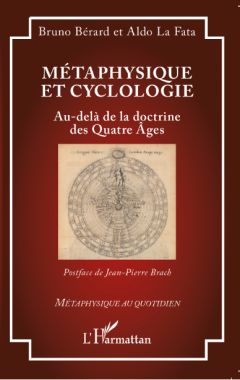
Is time linear, cyclical, or open to eternity? From ancient India to contemporary thought, through the great religious traditions, philosophy, and science, this book offers a broad overview of doctrines concerning time and cosmic cycles, particularly the Hindu doctrine of the Four Ages.
Its ambition, however, is above all metaphysical: to go beyond cosmological representations of becoming in order to examine their meaning, universal significance, and limitations. Is the world truly undergoing spiritual decline? How should we interpret the “signs of the times”? And, above all, is knowledge of cosmic cycles necessary for spiritual realization?
Through their analyses and a concluding dialogue that brings their respective perspectives into conversation, Bruno Bérard and Aldo La Fata invite readers to distinguish cosmology, history, and metaphysics, without losing sight of what is essential: the possibility for human beings to attain the timeless within time itself.
With an afterword by Jean-Pierre Brach.
Contents
Introduction – General Issues
Introduction – Standpoint and Perspectives
PART ONE. History and Typology of Traditional Doctrines of Antiquity
Chapter I – The Cyclologies of the Ancients
Chapter II – Religious Cyclologies
PART TWO. The Revival of the Cyclical Conception in European History
Chapter III – Cyclologies in the Middle Ages
Chapter IV – Cyclologies in the Renaissance
Chapter V – Cyclologies in the Modern Era
Chapter VI – Cyclologies in the Twentieth Century
Chapter VII – Conclusions on Cyclologies
PART THREE. Scientific Perspectives on Cycles and Time
Chapter VIII – Cycles in the Natural Sciences
Chapter IX – Cycles in Other Sciences
Chapter X – Time in the Physical Sciences
Chapter XI – Time in Philosophy
PART FOUR. Metaphysics of Cyclology
Chapter XII – On the Decline of the World
Chapter XIII – On the Interpretation of the World
Chapter XIV – Toward an Anthropology of Cycles
Chapter XV – Prophecy and Eschatology
Chapter XVI – On the Signs of the Times
CONCLUDING DIALOGUE
AFTERWORD BY JEAN-PIERRE BRACH
Essential Bibliography
Index of Names
Detailed Table of Contents
Excerpt
Put differently, whereas the doctrine of the Four Ages remains cyclical, cosmic, continuous, and impersonal, Spengler historicizes cyclicity by turning it into a morphology of civilizations; Georgel extends this approach by reducing prophecy to a pessimistic vision of decline. Barbault, through the great planetary conjunctions, objectifies cycles and gives historical time greater density, at the risk of determinism. Conversely, Le Cour gives the cycle an eschatological dimension: the Age of Aquarius tends to become a quasi-salvation. Phaure goes even further by transforming cosmic conditions into a sacred chronology, from Adam to the Parousia, structured by an astronomical and numerological framework—with the risk of establishing a sacred calendar. Bolton falls into the same temptation by seeking to make the end of a cycle coincide with the “end of time.”
Teilhard de Chardin, for his part, replaces the cycle with an arrow: history is directed toward a fulfillment (the Omega Point). Rudhyar, in a different register, interiorizes cyclicity and transforms it into a pattern of maturation and evolution of consciousness. Auclair represents the limiting case: all cyclicity is subordinated to Christian eschatology and refocused on prayer, grace, and surrender. Panunzio, finally, emphasizes the dramatic character of the end, interpreting modernity as a terminal phase moving toward a theological-historical conclusion, while Fulcanelli transposes the crisis of the end of an era onto the hermetic plane: not the end of time, but transmutation.
Thus, in every case, the cycle ceases to be strictly impersonal—becoming historicized, directed toward an end, eschatologized, or interiorized—precisely what Guénon rejected: confusing the cosmology of the world with the question of salvation, which belongs to another order.
We must therefore return to the doctrine of the Four Ages as it was originally formulated and recognize that its intrinsic prophetic dimension undoubtedly gives it theological and spiritual significance. In fact:
- The world is never abandoned by the Principle.
- Grace (or spiritual influence) adapts to human capacities.
- Spiritual realization is not made impossible by decline, but redirected toward what is essential.
This avoids all cyclical fatalism (“everything is lost”), all spiritual progressivism (“the future will save us”), and all cosmic millenarianism (“a new age will automatically bring salvation”).
We may conclude by saying that prophecy seems to us to constitute the only point of convergence between the metaphysical perspective and cyclology, especially that of the doctrine of the Four Ages. Of course, one might be tempted to add that, within a Christian context, the doctrine contributes nothing directly. Its prophetic dimension will always intrinsically lack a collective eschatology, an ultimate unveiling.
(Extract from Chapter XV: Prophecy and Eschatology)
Notice of publication
Is time a line, a circle, or a spiral? Does human history follow a path of continuous progress, a succession of cycles, or an inexorable decline?
From ancient traditions to contemporary doctrines, from East to West, this book offers a broad overview of cyclical conceptions of time, examined in the light of modern scientific and philosophical perspectives.
Yet beyond cyclological doctrines, a fundamental question remains: what can the cycles of the world teach us about ultimate reality and the spiritual destiny of human beings?
Bringing together the history of ideas, cosmology, and metaphysics, Bruno Bérard and Aldo La Fata invite readers to distinguish representations of becoming from metaphysical knowledge properly so called.
With an afterword by Jean-Pierre Brach, clarifying the relationships between time, cosmology, and metaphysics


