


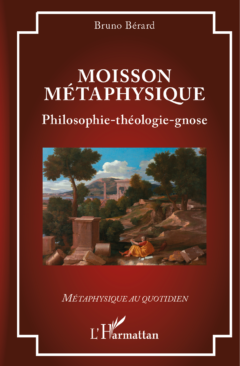
Metaphysical Harvest: Philosophy, Theology, and Gnosis brings together several decades of research and articles devoted to metaphysics, which until now have been scattered across various publications, primarily digital ones. Without claiming to replace personal study, this work offers a structured journey through some of the major questions of first philosophy: the distinction between reason and intelligence, the relationships between metaphysics, theology, and religion, the nature of gnosis, the language of silence, love, beauty, prayer, and eschatology. Organized into three main parts—Metaphysics and Philosophy, Metaphysics and Theology, and Metaphysics and Gnosis—it offers an accessible synthesis of an approach that could be described as “metaphysical-mystical,” drawing in particular on the works of Jean Borella and the universal metaphysical tradition.
Contents
Foreword
Introduction
PART ONE. METAPHYSICS AND PHILOSOPHY
Chapter 1. The Three Modes of Philosophizing
Chapter 2. Reason and Intelligence: The Two Faces of the Mind
Chapter 3. Believing, Knowing, and Understanding
Chapter 4. Metaphysics as Anti-Dogmatism and as a Non-System
Chapter 5. Metaphysics: The Third Way
Chapter 6. “Metaphysics for All”
Chapter 7. Paradoxes of Reason, Paradoxes of Intelligence
Chapter 8. Metaphysics and Axiology
Chapter 9. A Return to a Metaphysics of Beauty
Chapter 10. Like a Fly Behind a Windowpane
PART TWO. METAPHYSICS AND THEOLOGY
Chapter 11. Metaphysical Practice Is Religion
Chapter 12. Theology of Religions
Chapter 13. Metaphysica sine theologia nihil
Chapter 14. Logos-Centered Metaphysics
Chapter 15. Metaphysics, the Language of Silence
Chapter 16. The Metaphysics of Love
Chapter 17. Chronosophy—Reflecting on the End of Time
Chapter 18. On the Essence of Christianity
Note on the Unity of Religions
Chapter 19. The Japanese Concept of Aida
Chapter 20. Must One Be Intelligent to Be Saved?
PART THREE. METAPHYSICS AND GNOSIS
Chapter 21. Esotericism, Metaphysics, and Gnosis: Key Elements
Chapter 22. Gnosis: Mystical Theology
Chapter 23. “Non-Two,” “Non-One,” “Non-Three,” “Non-Thousand”
Chapter 24. The Christological Hologram or the Holographic Christ
Appendix. The Word, the Logos Outside of Christianity
Chapter 25. Healing in Two Stages
Chapter 26. On Prayer
Excerpt
First, let us clarify “metaphysics .” A metaphysical expression is a language transparent to the intellect; this language serves to point to that which lies beyond language. In this regard, metaphysics is the ultimate hermeneutics, the final interpretation that cannot itself be interpreted (Jean Borella). Furthermore, metaphysical language suggests its own erasure, its self-abolition.
Indeed, language, discourse, words, and concepts are merely tools that enable the intellect to access Reality, which transcends them—the light or truth that does not reside in words.
If the intellect naturally concerns itself with supernatural things, it is because the intellect is not part of the natural world. “The intellect comes through the door” or “from the outside,” says Aristotle1. It is therefore absolutely necessary to renounce what we call our own intellect, the vanity of our own little light, and to make room for the true Light to appear.
Now, in addition to the intellectual mode, metaphysics can also employ the symbolic mode. According to Jean Borella, the symbolic makes one see, whereas the intellect makes one hear. This is why religious metaphysics often emphasizes the use of symbols. Symbols make it possible to compensate for the limitations of language.
Religions are, in fact, the natural home of metaphysics, for, in the broadest sense, metaphysics is both a science and a path. Metaphysics without mysticism remains at the level of reason and does not rise to the level of the intellect, where it is illuminated. This, moreover, is Plato’s “superiority” over Aristotle. Aristotle founded science through rigorous scientific discourse validated by logic (he is, in fact, the founder of logic), but he did so at the cost of renouncing access to the “Ideas,” the Platonic doctrine that he was never able to understand, even though he had been Plato’s student for 17 or 19 years.
Since the language of metaphysics is merely a tool—a means of accessing the Light—it is therefore evident that every religion possesses its own theological language, as well as its own metaphysical language. As such, each religion has developed a specific language and uses specific symbols to guide faithful servants toward God. This is universal and illustrated by a hadith qudsi: “I am [says God] as My servant conceives Me to be”2
However, while certain intellectual tools and symbols are common to many religions, this is by no means the case for all of them. There is therefore no “supra-metaphysics,” no “transcendent unity,” no “Religio perennis.” At best, we can speak of an “analogical unity of religions” (Borella), in which each religion is unique in its form and language.
This means, therefore, that metaphysics does not provide a supreme language superior to that of religions. Thus, the language of a (revealed) religion is adequate for expressing universal metaphysical (or ultimate) concepts, but not the reverse. It must also be emphasized that there is a certain arrogance behind the presumption of the “transcendent unity of all religions.” The very notion presupposes that the “seer” places himself above all religions—he sees and understands all religions and is essentially omniscient; he is God himself. Such an attitude stands in direct opposition to the humility and reverence that all authentic religions inspire in their sages, saints, and faithful.
Christian metaphysics is therefore quite simply metaphysics expressed in Christian language—the language of its own revelation. But there is even more to it: it is also the metaphysics to which we arrive through Christian language, and which we would never have reached without that language. For example, the Christian Trinity leads us to the identity of the person and the relationship. Indeed, in the Trinity, the persons of the Father and the Son are revealed to be pure relationships (fatherhood and sonship), and it is there, too, that the relationship of love and self-giving is revealed to be a person: the Holy Spirit. We can thus move from a metaphysics of being to a metaphysics of relationship.
Footnotes
- On the Generation of Animals, II 3, 736a, 27–b 12.[↩]
- “I am as My servant conceives Me to be, and I am with him when he calls upon Me. If he calls upon Me in private, I call upon him in My presence; if he calls upon Me in a gathering, I call upon him in a gathering better than his own…”; Abd al-Qâdir al-Jazâ’iri, The Book of Stops, trans., intro., and notes by Max Giraud, AlBouraq éditions, 2012.[↩]
Notice of publication
Drawing on several decades of study in metaphysics under numerous masters, from Plato to Jean Borella, this book offers a comprehensive vade mecum within a broad perspective spanning from the origins to the ultimate ends.
The journey will certainly follow the paths of metaphysics, but also those of theology, and even that of “mystical metaphysics”—a term coined by Aldo La Fata and one that we champion. It allows us to sketch out what true gnosis might be.
Admittedly, nothing can replace long hours of solitary study and meditation; however, gaining access here—in the most accessible language possible—to what has seemed fundamental to certain masters can mark out a path that, in any case, can only ever be traveled alone.


