
Article published on NIYX.com June 20, 2026 – Here
Machines calculate, but do they understand?
Based on the fundamental distinction between reason and intelligence—a distinction overlooked by much of modern thought—this article argues that the term “artificial intelligence” is a misnomer. Current systems do not think, do not understand, and are not free; they harness a new power of computation and simulation. From Kant to Turing, from Leibniz to Jean Borella, this reflection sheds new light on the debates surrounding AI, its dangers, its promises, its energy costs, and its impact on the future of human societies.
- On the Difference Between Reason and Intelligence
- Kant’s Rejection of Intelligence
- Consequences of the Kantian Error
- AR, artificial reason, or AME, artificial mental energy
- A Comparison of Machine “Intelligences” with Human Intelligence
- On the Determinism of Machines and Human Freedom
- From the Rights of Machines to Those of Users
- The so-called danger of “AI”
- Technology and Jobs
- From Technological Advances to the Myth of Progress
- Footnotes
From French-speaking academic computer science circles to the French translation of a recent encyclical by Leo XIV and, of course, in everything reported on the subject in the media and on social media, the term “Intelligence artificielle” seems well established, translating, without further reflection, the Anglo-American expression “Artificial Intelligence” (“intelligence artificielle”) proposed by John McCarthy in 1955 and reinforced during the famous conference: the 1956 Dartmouth Summer Research Project on Artificial Intelligence 1, after Alan Turing, in his 1950 article “Computing Machinery and Intelligence,” published in Mind, had made the connection.2
However, this Anglo-Saxon, typically post-Kantian designation of “intelligence” is flawed and gives rise to numerous misinterpretations.
On the Difference Between Reason and Intelligence
Throughout history, at least since Plato3, philosophy has clearly distinguished between reason and intelligence. Reason reasons or calculates, subject to both the object it considers and the logic that governs it, whereas intelligence is the faculty of understanding calculation or reasoning. Reason can certainly construct, but only intelligence can understand. Reason operates within the conceptible, while intelligence—or the intellect—operates within the intelligible.
Thus, it is not through reason but through intelligence that we know; indeed, it is said that intelligence receives meaning, with the mind functioning as a mirror (speculum in Latin), or that intelligence comes “from outside” or “through the door” (Aristotle)4. The exercise of this faculty, writes Leibniz, is called intellection and constitutes a distinct form of perception linked to the faculty of reflection5. Simone Weil will say, in essence, that the intellect, in its act of intellection, is perfectly free, and that no authority, no will—not even our own!—has power over it: one cannot force oneself to understand what one does not understand—as G. E. Moore states, that we absolutely cannot think what we cannot think, or as Jean Borella asserts, that intellection is an act of intellectual vision, not an act of will. We will cite this synthesis:
Rational nature surpasses sensible nature with regard to the object of knowledge, for the senses cannot in any way know the universal, which is the object of reason. But intellectual nature surpasses rational nature with regard to the mode of knowing intelligible truth; for intellectual nature immediately grasps the truth, whereas rational nature attains it only through the inquiry of reasoning.6
Clearly, it is not this kind of intelligence that is meant by the term “artificial intelligence.”
Kant’s Rejection of Intelligence
We can trace this widespread distortion of the meaning of “intelligence” back to Kant, when he reversed the functions of the two faculties, placed reason above all else, and reduced intelligence to what would become the subject of study for numerous sciences such as cognitive psychology, cognitive neuroscience, and cognitive linguistics…7. But let there be no mistake: in terms of knowledge (the act of knowing), these sciences essentially study mental operations, but not intellection (of the nous, of the intellectus) in the proper sense of the philosophical tradition8, bearing in mind that
knowledge, in and of itself, at whatever level one considers it, can ultimately only be intuitive—that is, “vision” (or hearing), a direct and unitive perception of its object. That there is only intuitive knowledge is self-evident, not the conclusion of a line of reasoning. Moreover, it is impossible to provide a definition of knowledge; it is primary, irreducible, and non-generative.9
Yet Kant proceeds from his own conception, according to which this intellectual intuition does not exist: “a particular, intellectual kind of intuition—but one that is not our own, the very possibility of which we cannot even glimpse,” he writes10. As for reason, he fails to see that reason cannot limit reason, cannot critique itself—which is the foundation of his project of “Critique of Pure Reason”—even though he knows full well, on the other hand, that the sea does not limit the sea11. This is his “critical slumber,” as Jean Borella would put it.
Sensory experience is indeed a meaningless phrase if it is not contextualized. Certainly, for man, nihil est in intellectu quod non fuerit in sensu (nothing is in the intellect that was not first in the senses), but only insofar as one adds its Leibnizian complement: “nisi ipse intellectus” (except the intellect itself).12
Hegel puts it another way: “Speculative philosophy must not reject this proposition [‘nihil est in intellectu quod non prius fuerit in sensu’], but it must also admit the opposite principle: ‘nihil est in sensu quod non prius fuerit in intellectu’ […]13, or as Leon Trotsky puts it:
If we reduce the question to experience in its strictly empirical sense, then it is impossible for us to arrive at any judgment regarding the origin of species, much less the formation of the Earth’s crust. To say that experience is the basis of everything is to say too much or to say nothing at all (Writings, 1939–40).
Consequences of the Kantian Error
Admittedly, this Kantian error has been vigorously contested from the very beginning as a “doctrine of fallen and perverted reason” (Pyotr Yakovlevich Chaadaev14) and continues to be so to this day. Hegel remarked that “wanting to know before knowing is as absurd as the wise precaution of that schoolboy who wanted to learn to swim before venturing into the water”15, and this rationalist reductionism was refuted by Antoine Augustin Cournot, Antoine Blanc de Saint-Bonnet, Charles Péguy, Charles Maurras, Jacques Maritain, Étienne Gilson, Claude Tresmontant, Jean Madiran, Émile Poulat, Jean Borella… René Berthelot and Raymond Poincaré referred to it as an “untenable sophism”16.
However, the dictatorship of reasoning: rationalism (like nineteenth-century scientism, which is closely related to it) persists in today’s minds as paleo- and neo-positivism: “a sinister refrain […] that in fact derives from Kantianism.”17
In terms of knowledge, we must at the very least distinguish between two orders: knowledge through participation, which is that of the intellect— —that accesses the intelligibles and achieves a (cognitive, not ontological) subject-object union with reality; and knowledge through abstraction, that of reason, reduced to the conceptible. The latter steadfastly keeps the subject and the object separate and has done nothing but recreate an abstract image of reality.
These two faculties of the mind—reason and intelligence—naturally complement one another18, but the reduction of human thought to reason alone—equated with an intelligence that is thereby distorted—is precisely the cause of much confusion. This confusion disappears if we speak instead of AR, “artificial reason”19, or even AME, “artificial mental energy”20.
AR, artificial reason, or AME, artificial mental energy
The pioneers of this AI were under no illusions. Admittedly, they used the word “intelligence” in the post-Kantian sense—a sense widely accepted in modern science precisely because of its status as a scientific discipline—but they did not claim that this mechanical “intelligence” was equivalent to that of human beings. Specifically, they spoke only of simulation or imitation:
- “Every aspect of learning or any other feature of intelligence can, in principle, be described so precisely that a machine can be made to simulate it.”21
- The Game of Imitation22
Consequently, comparisons between machine intelligence and human intelligence do not make much sense, except to distinguish, precisely, between reason and intelligence, as Professor Sarah Spiekerman has done (see below).
More directly related to what should be called AR or AME, we can easily compare the external energies that humanity has acquired throughout history.
These are essentially (thermo-)mechanical forms of energy:
- Wood fire (biomass) – 1 million years (?)
- Animals (domesticated living energy) – c. 8000 BCE
- Water and wind (natural energy) – c. 5000 BCE
- Fossil fuels (geological energy) –18th century (coal), 19th century (oil, gas)
- Atomic nucleus (nuclear energy) – 1950.
In this series, it is mental energy that humanity began to add to itself, let’s say around the 1950s. However, we can trace the first concept of a computer back to 1837: Charles Babbage’s Analytical Engine (which, thanks to punch cards, already included a memory and a computing unit). In the meantime, there was Konrad Zuse’s Z3 in 1941, the first functional electromechanical computer (binary calculation and program on punched tape); the British Colossus of 1943–44, the first programmable electronic computer (though specialized in cryptanalysis); IBM’s Mark I, with the commissioning of an automatic-sequence calculator in 1944; John Mauchly and J. Presper Eckert’s ENIAC in 1945, the first general-purpose electronic computer (18,000 vacuum tubes, 30 metric tons, 150 kW), and the Manchester Baby (or Small-Scale Experimental Machine, SSEM) by Frederic C. Williams and Tom Kilburn in 1948, not to mention the first industrial computer (with direct-access hard drive), which ushered in business computing: IBM’s RAMAC 305 in 1956.
This mental energy is always mechanical in nature (calculations of numbers or concepts), that is, a matter of reason rather than intelligence, even though current AI models are capable of simulating or imitating behaviors.
A Comparison of Machine “Intelligences” with Human Intelligence
One way to clear up this relative confusion caused by terminology—which prevails both among the general public, following famous science fiction films, and in the minds of certain scientists less versed in precise philosophical terminology—was undertaken by Sarah Spiekerman23. After distinguishing between reason and intelligence, she precisely characterized AI systems in comparison to human beings.
In addition to arguments based on the state of the art, the comparison criteria she identified are that AI systems (1) have little human-like information, (2) cannot react like humans, (3) cannot think like humans, (4) lack human motivation, and (5) do not possess autonomy comparable to that of humans24.
On the Determinism of Machines and Human Freedom
Determinism and freedom turn out to be essential distinguishing features between machines and humans, since we have come to the point where we must distinguish between them!
Human freedom points directly to the essence of man, based on his ontological foundation as a free animal. It even takes precedence over the Aristotelian “rational animal”25, as the principal attribute of man according to Rousseau:
It is therefore not so much reason that distinguishes humans from other animals as their capacity to act freely.26
That is to say, behind unconscious (psychoanalysis), cultural (sociology), and neurological (neuroscience, psychobiology) determinisms, free will remains in man. One can be conditioned and yet free; the freedom in question here refers to the exercise of the will.
This exercise of the will is thus the result of a thoughtful choice (Aristotle) aimed at the good (Plato), guided by reason (Descartes, Leibniz), lifting humans out of the state of nature (Rousseau), and following a moral law that they establish for themselves (Kant).27
Hence, we are “condemned to be free,” as Sartre would say28 and thus responsible for our actions:
Man is condemned to be free; condemned because he did not create himself, and yet, on the other hand, free because, once cast into the world, he is responsible for everything he does.29
Philosophically speaking, there is a negative definition of freedom—as the absence of constraint or determination—and a positive definition—as the autonomy or spontaneity of the will. It is the latter that is most essential, and this can be demonstrated by reductio ad absurdum.
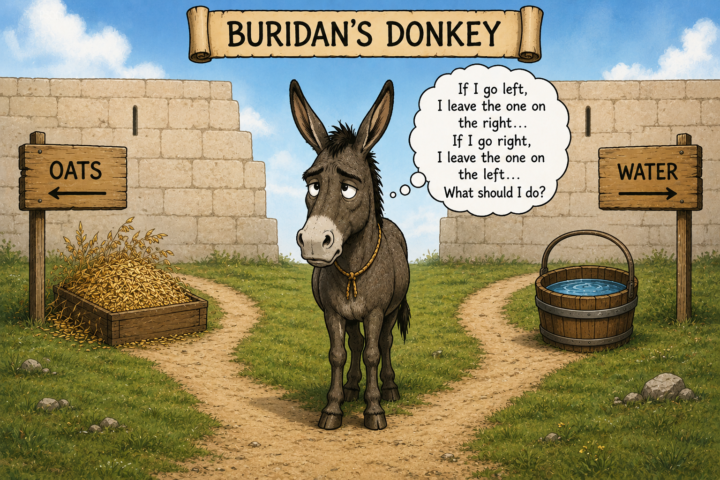
If being free were merely a matter of being without determination, the freest person would be the most indeterminate, and “totally free” would then mean being completely indeterminate, which makes no sense. The proof by contradiction is well known: a man entirely subject to—and thus reduced by—his determinations would be a pure automaton: an “automaton spirituale”30. This is illustrated by Buridan’s paradox: Unable to choose which to eat first, a donkey will die of hunger and thirst between its bowl of oats and its bucket of water31.
Exposed as absurd in the thought experiment of “Buridan’s donkey,” this means that determinations—which are inevitable—do not stand in opposition to freedom; rather, they form the necessary foundation upon which freedom may—or may not—be exercised. And if freedom now characterizes the power or will to do something, it is also through determined actions—according to determined ends and means—that it will be exercised. Everything is therefore determined: man and his environment, the end and the means of his action. This means that freedom cannot, under any circumstances, consist in escaping in any way from internal or external determinations; on the contrary, it lies in the acceptance, on the one hand, of the determinations intrinsic to the order of things and, on the other hand, of those corresponding to the ends and means of the chosen action. It is therefore neither submission nor resignation, but rather a voluntary, and thus free, acceptance […] of a mission.32
This capacity within us to freely do what we must, Descartes admirably calls “generosity,” Corneille calls “heart,” and Plato calls “courage,” which in Greek is andréia, a quality proper to the andros (man).33
As we can see, human freedom and determinism are not at all on the same level, and human freedom transcends all determinism (except, perhaps, in cases of extreme pathology).
On the other hand, the machine itself will always be entirely determined, and even the appearance of autonomy or freedom will never be anything more than the result determined by a specific algorithm or program. The same applies to the generation of consciousness or emotional behavior as it does to volitional autonomy—at best, imitations or simulations, as Alan Turing and John McCarthy put it.
From the Rights of Machines to Those of Users
By speaking inappropriately of “intelligence,” some have come to believe that if AI were to gain consciousness and autonomy, then it should be granted rights (David Chalmers, Thomas Metzinger, or Nick Bostrom). Such a question would never have arisen in the context of AR or AME. Others have also raised the possibility of endowing certain autonomous robots with “electronic personality” (European debates of the 2010s)34; https://eur-lex.europa.eu/legal-content/EN/TXT/PDF/?uri=CELEX%3A52017IP0051&utm.)). Fortunately abandoned, talk of an “electronic person” would have added to the existing confusion surrounding “intelligence.” This would have shifted the traditional ontological definition—“an individual substance of a rational nature” (Boethius, Thomas Aquinas)—to a functional definition: “that which acts autonomously within a network of responsibilities”!
Today, it seems that rights will primarily concern AR users, depending on their nationality; for example, when the U.S. government orders Anthropic to suspend foreign access to its most advanced models (Mythos 5 and Fable 5) in June 202635. Essentially, this is about limiting cognitive capacity itself—that of others. Here we see the concept of “artificial mental energy,” which must be prevented in others, just as one might prevent them from accessing geological energy (Cuba…).
The so-called danger of “AI”
As anticipated, the danger does not come from the machines themselves, but from their human designers and users, or from the degree of autonomy delegated to them—despite their rational limitations, that is, in this case, being logic-based or lacking intelligence.
This is true of all technology, the use of which falls under the user’s responsibility—as, for example, in certain countries where the sale of weapons is legal and only criminal use is punishable, since the law specifies that causing injury or murder is illegal. However, when it comes to “AI” technology, many uses appear criminal, or at the very least unethical, but the law has not yet classified them as such, or they are in the hands of political or financial powers that are untouchable, or even unidentifiable or unstoppable criminals.
Thus, while the atomic bomb currently has no users, AI-related technologies already have many:
- lethal autonomous weapons (combat drones…),
- large-scale facial recognition (China, others36) and behavioral scoring of citizens37,
- political and psychological manipulation (influencing individual voters, spreading targeted disinformation campaigns, malicious deepfakes, etc.),
- economic exploitation of workers (underpaid data annotators, moderators exposed to traumatic content, low-paying digital microtasks…),
- human scoring (statistical biases in the evaluation of candidates, risk of recidivism, etc.),
- behavioral addiction systems (algorithms designed to maximize screen time, exploitation of psychological vulnerabilities…),
- automated fraud systems (personalized phishing, voice spoofing, romance scams…),
- artificial opinion-making (automated propaganda creating the illusion of consensus…),
- restriction of civil liberties (aiding political repression by identifying opponents, mapping networks, analyzing communications, etc.).
More generally, “AI” provides new tools, and it is only their use—or misuse—that can be condemned. It goes without saying, but the real danger, ultimately, lies in the gradual replacement of human judgment itself. Put another way, the danger is not that “AI” will make bad decisions, but that humans will cease to exercise their own powers of discernment and responsibility by delegating to it what has traditionally been the domain of human intelligence. Ultimately, this is not so new; the danger comes from humans themselves and their limited reason, when it is deprived of intelligence.
Technology and Jobs
The negative impacts of technology have always been known in advance, but the critics of “progress” have always lost.
One of the oldest texts, by Zhuāng Zhōu (4th century BCE), criticizes mechanized irrigation38. We know of the watermill blocked by Emperor Vespasian (9–79 CE) to prevent unemployment, or the fulling mill invented near Grenoble in the 11th century, which, however, would have to develop slowly and discreetly in the countryside, just like the spinning wheel and, eventually, the watermill. We must not forget the British Parliament’s decision in 1813 to hang members of the Luddite movement, who were attempting to destroy the mechanical looms that were eliminating jobs.
Similar job losses are currently underway due to the implementation of “AI.” The IMF estimates that 40% of global jobs are at risk—60% in developed economies39—but a portion of these jobs will be transformed rather than eliminated. The World Economic Forum (WEF) forecasts that 92 million jobs will be displaced or eliminated, but this will be offset by the creation of 170 million new jobs40. Goldman Sachs estimates that 300 million jobs will be affected or at risk of automation due to “AI,” but the impact on unemployment is expected to be limited to 0.5 percentage points during the transition41.
The jobs most affected include data entry, administrative secretarial work, basic accounting, call centers, standard translation, writing repetitive content, and basic document analysis…
Job shifts—which are not without their challenges and do leave some people behind—are nothing new in the West. Agriculture accounted for about 70% of jobs in 1800, compared to 3% today. Manufacturing peaked in 1950 at 45% of jobs, falling to about 20% today, while the service sector now accounts for around 80%.
While agricultural mechanization reduced agricultural employment from 70% to 3%, and industrial automation and deindustrialization reduced it from 45% to 20%, the question is: to what extent will the use of “AI” reduce jobs in the service sector? And what will the “unnecessary” people do? Put another way, after agriculture, industry, and services, what will be the fourth major sectoral transformation?
Is this not already well known, given that 20% of people in Western societies are currently left behind?
From Technological Advances to the Myth of Progress
Behind technological advances often lies the myth of progress. Unsurprisingly, the idea of progress took shape as a system in the early 18th century42, that is, at the dawn of the Industrial Revolution: the British agricultural revolution, the first factories and technical innovations, the rise of global trade… This myth is the notion and conviction that “everything is intrinsically destined to improve, almost naturally and in perpetuity: knowledge, technology, reason, morality, happiness, language, and public institutions”43—a belief that would ultimately prove costly for the economic, social, and political utopias of the 19th century.
Such a conviction was, of course, quickly challenged, notably in Karl Kraus’s famous article44, where it is dismissed as “a cliché or a slogan, but certainly not a concept”45:
Progress is the prototype of a self-perpetuating and self-sustaining mechanical or quasi-mechanical process that repeatedly creates the conditions for its own continuation, notably by producing drawbacks, inconveniences, and damages that only further progress can overcome.46
Yet this myth persists relentlessly and must still be denounced today, as done by Jacques Bouveresse: The Modern Myth of Progress47 or Georg Henrik von Wright: The Myth of Progress48 or others.
In other words, progress has remained the self-solution to the problems it creates; “progress progresses!” as Heidegger might say. One need only label those who denounce the evils caused by progress as “anti-progress” to exonerate progress, the perpetual solution of itself and to itself.49
Just look at today’s “achievements”: pollution of the land, sea, and air, a drastic reduction in biodiversity, various climate disasters, the hoarding of 70% of the Earth’s wealth by a select few, astronomical national debt, financial totalitarianism (Viviane Forester), and 3 billion people living in poverty (worldbank.org), we are reinforced in our belief that the myth of progress is just that—a myth.
It will be no different with “AI.” Based solely on the criteria of resource use and pollution, current estimates put “AI”-related consumption at 150 TWh/year50 (which is more than the combined annual consumption of Switzerland and Belgium, and one-third of data center consumption: 450 TWh/year) and 50 million tCO₂/year. The IEA’s projection for 2030 cites nearly 1,000 TWh/year51, of which almost half is for AI, amounting to some 200 MtCO₂/year (equivalent to Spain’s annual emissions).
Regardless of its other merits, this level of energy consumption does not seem reasonable.
Footnotes
- See the proposal at https://parhamdata.com/Dartmouth_1955_Proposal_for_AI_Research.pdf.[↩]
- Oxford University Press, vol. 59, no. 236, October 1950.[↩]
- Plato, The Republic, Books VI and VII. Also Phaedrus 247c-d: “The true essence—colorless, formless, and intangible—can be contemplated only by the soul’s guide, the intellect. Around the essence lies the realm of true science. […] Every soul that is to fulfill its destiny loves to see the essence from which it had long been separated, and delights in the contemplation of truth.”[↩]
- On the Generation of Animals, II 3, 736a, 27–b 12. Also: “The intellect (nous, intellectus) is the most wonderful thing within us,” Nicomachean Ethics, 1177a.[↩]
- New Essays on the Human Understanding, Book II, Chapter XXI, § 5.[↩]
- Thomas Aquinas, Summa Theologica, Ia IIae, q. 5, a. 1, s. 1.[↩]
- The so-called cognitive sciences constitute an interdisciplinary field bringing together psychology, neuroscience, linguistics, computer science, philosophy, anthropology…[↩]
- Plato, Aristotle, Plotinus, St. Augustine, St. Thomas Aquinas, Dante, Leibniz, Malebranche, Simone Weil, Borella… [↩]
- Jean Borella, Love and Truth, Angelico Press, French version Amour et Vérité, L’Harmattan, 2011, p. 110[↩]
- Critique of Pure Reason, trans. J. Tissot, Paris: Ladrange, 1845, vol. I, p. 462.[↩]
- Critique of Pure Reason (trans. J. Tissot, op. cit.), p. 444.[↩]
- New Essays on Human Understanding, Book II, Chapter 1, § 2.[↩]
- Hegel’s Logic, trans. Augusto Véra, Paris: Ladrange, 1859, vol. I, pp. 217–218.[↩]
- Paul Evdokimov, Christ in Russian Thought, Paris: Cerf, 1970, p. 40.[↩]
- Hegel’s Logic, trans. Augusto Véra, Paris: Ladrange, 1859, vol. I, p. 222.[↩]
- René Berthelot, A Utilitarian Romanticism: An Essay on the Pragmatist Movement, Paris: Alcan, 1911, p. 299.[↩]
- Les métaphysiques principales (The Principal Metaphysics), Paris: O.E.I.L., 1989, p. 4.[↩]
- See https://metafysikos.com/la-raison-et-lintelligence-les-deux-faces-de-l-esprit/.[↩]
- https://philos-sophia.org/unmasking-ai/; French version: https://metafysikos.com/l-ia-demasquee/[↩]
- A phrase coined by François Chenique, Comprendre la logique moderne (« Understanding Modern Logic »), Dunod, 1974.[↩]
- See John McCarthy et al., Dartmouth Summer Research Project on Artificial Intelligence.[↩]
- Alan Turing, “Computing Machinery and Intelligence,” op. cit.[↩]
- Professor Sarah Spiekermann has been the director of the Institute for Information Systems and Society at the Vienna University of Economics and Business (WU Vienna) since 2009. A renowned scholar in the field of digital ethics, in 2016, she founded the Privacy & Sustainable Computing Lab at the University of Vienna (renamed the Sustainability Computing Lab in 2020) and served as vice chair of the Institute of Electrical and Electronics Engineers (IEEE) working group that developed the first model process for designing ethical systems (IEEE Standard Model Process for Addressing Ethical Concerns during System Design): the IEEE Std 7000™-2021 standard.[↩]
- See Spiekermann, Sarah. 2021. “On the Difference Between Artificial and Human Intelligence and the Ethical Implications of Confusion.” In Philosophical Handbook of Artificial Intelligence, edited by Klaus Mainzer, 1–20. Munich: Springer Verlag. French version on Metafysikos: https://metafysikos.com/sur-la-difference-entre-lintelligence-artificielle-et-lintelligence-humaine-et-les-implications-ethiques-de-lintelligence-artificielle-et-de-lintelligence-humaine-l/.[↩]
- Aristotle, Politics, Book I, Chapter 1, Section 4.[↩]
- Discourse on the Origin and Foundations of Inequality Among Men, Amsterdam: M. M. Rey, 1755, p. 31.[↩]
- cf. https://metafysikos.com/liberte-egalite-fraternite/[↩]
- Sartre, Being and Nothingness (1943), Paris: Gallimard, 1976, p. 612.[↩]
- Sartre, Existentialism Is a Humanism, Paris: Nagel, 1946, p. 37.[↩]
- Spinoza, Treatise on the Reform of the Intellect, trans. Ch. Appuhn, § 85. See Bruno Bérard, Metaphysics of the Paradox, L’Harmattan, 2019, vol. I, pp. 120–123.[↩]
- Buridan (1292–1363), following Aristotle, uses the absurdity of this “senseless alternative” for his demonstration; see Benoît Patar, Dictionary of Medieval Philosophers, Montreal: Fides – Presses philosophiques, 2006.[↩]
- Bruno Bérard, The Democracy of the Future: The Sharing of Power, L’Harmattan, 2022. Excerpts available on metafysikos.com: https://metafysikos.com/liberte-egalite-fraternite/ (and https://metafysikos.com/de-la-democratie-a-la-diacratie/).[↩]
- Jean Borella, Marxism and the Christian Sense of History, Paris: L’Harmattan, 2016, p. 179, which we follow here.[↩]
- European Parliament Resolution of February 16, 2017, with recommendations to the Commission on Civil Law Rules on Robotics (2015/2103(INL[↩]
- Anthropic then disabled these models more broadly, believing it was difficult to distinguish authorized users from others; Mrinmay Dey, Jeffrey Dastin, and Chris Thomas, “Anthropic disables top-tier AI models after U.S. order limiting foreign access,” Reuters, June 13, 2026.[↩]
- This is well known in China, but it is also the case in Russia (particularly in Moscow), India (several national and regional projects), the United Arab Emirates, Singapore…[↩]
- It appears that there is currently no single “national social score” in China assigned to each citizen for all aspects of their life. However, there are administrative blacklists, automatic penalties for certain behaviors (fraud, failure to pay, etc.), and local rating programs…[↩]
- Works, Ch. XII, 11 (trans. Jean-Jacques Lafitte); see Conversations with ChatGPT on Humanity, the World, God, and Artificial Intelligence. Artificial Intelligence or Artificial Reason? Afterword by Professor Johannes Hoff, L’Harmattan, 2024, pp. 16–17.[↩]
- Kristalina Georgieva, “AI Will Transform the Global Economy. Let’s Make Sure It Benefits Humanity,” IMF blog, Jan. 14, 2024.[↩]
- See the Future of Jobs 2025 report.[↩]
- “How Will AI Affect the U.S. Labor Market?”, Mar. 18, 2026, https://www.goldmansachs.com/insights/articles/how-will-ai-affect-the-us-labor-market?[↩]
- Frédéric Rouvillois, The Invention of Progress, 1680–1730 (1996), CNRS, 2011.[↩]
- See https://metafysikos.com/la-science-serait-elle-intrinsequement-scientiste/.[↩]
- “Der Fortschritt” (Progress), in Simplicissimus, then issues 275–276 of Fackel (“The Torch”).[↩]
- Jacques Bouveresse, “The Myth of Progress According to Wittgenstein and von Wright,” Mouvements 2002/1 (no. 19), pp. 126–141, §2.[↩]
- Summary by Jacques Bouveresse, op. cit., § 3.[↩]
- Jacques Bouveresse, 2001 Lecture, ed. Agone, 2023 (posthumous edition).[↩]
- Evergreen, 2000.[↩]
- See https://metafysikos.com/la-science-serait-elle-intrinsequement-scientiste/.[↩]
- Hannah Ritchie, “How much electricity does AI consume? [2025 summary],” https://hannahritchie.substack.com/p/ai-electricity-2025?[↩]
- https://www.iea.org/reports/energy-and-ai/energy-demand-from-ai?[↩]
