


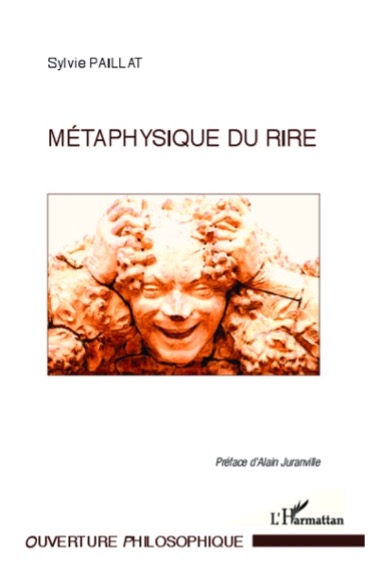
Holding a Ph.D. in Philosophy, affiliated member of CRICES, lecturer at ICES and secondary-school philosophy teacher, Sylvie Paillat is the author of the doctoral dissertation The Metaphysics of Laughter (L’Harmattan, 2014), as well as several articles on the subject, including The Aesthetics of Laughter: The Intelligence of Laughter or Feigned Stupidity (Le Philosophoire), The Mystical Experience of Laughter (Le Portique), and Castafiore’s Musical Laughter (Presses universitaires de l’ICES). She has also delivered lectures entitled Laughter in Crisis and Laughter as Medicine. Her interests also extend to the question of animality. She directed the conference Humanity and Animality: A Contemporary Debate between Speciesists and Antispeciesists, the proceedings of which were published by Hermann in October 2023.
Why has laughter occupied such a marginal place in the history of philosophy when it may well reveal one of the deepest dimensions of human existence? In this interview, Sylvie Paillat presents the central insights of her work The Metaphysics of Laughter. She argues that laughter, far from being merely a psychological or social phenomenon, can become a privileged avenue toward the great metaphysical questions: Being, consciousness, finitude, transcendence, and the meaning of the Logos. An original reflection that invites us to rethink philosophy itself in the light of a truly “metaphysical laughter.”
What first awakened your interest in metaphysics?
My interest in metaphysics arose very early, when I first encountered philosophy during my final year of secondary school. Even then, I was already fascinated by every inquiry into origins and by the great themes of the soul, Being, death, consciousness, language, and Platonic recollection as a possible path leading back through traces of previous lives toward the anhypothetical Origin—the very epicenter of metaphysics. Epistemology and political philosophy, by contrast, attracted me far less, except insofar as they revealed that, far from being separate from metaphysics, they are themselves rooted in what Aristotle calls the “science of first principles and first causes” and the “science of being qua being.”
Looking back from those first encounters to my present reflections and to The Metaphysics of Laughter (L’Harmattan, 2014), which grew out of my doctoral dissertation, I would say that three principal considerations explain this enduring attraction.
First comes wonder as the driving force of metaphysical inquiry. Wonder confronts us with the limits of rational human knowledge in the face of the otherness of reality, the mystery of origins, and the mystery of life and death. Leibniz’s famous question—“Why is there something rather than nothing?”—perfectly encapsulates the essence of metaphysical wonder.
Second is metaphysics’ liminal status, suggested by the Greek prefix meta: not only “that which comes after physics”1, but also “that which lies beyond,” in the Platonic sense of intelligible reality. Metaphysics thus helps establish either a continuity or a distinction—even a dualism—between philosophy and theology, matter and spirit, body and soul, the visible and the invisible, reason and intuition. It opens the possibility of conceiving another dimension of reality beyond the merely material and sensible world.
Finally, metaphysics is characterized by its appeal to divine transcendence, which Western rationalism and materialism have too readily dismissed as nothing more than one of humanity’s illusions.
Yet metaphysics has by no means disappeared. It continues to reappear in the failed aspirations of progressive ideologies that labor to rediscover traces of eternity in sustainable energy, purity in the carbon-neutral ideal of environmentalism, immortality—and even the denial of the human condition—in transhumanism, or moral perfection in the “empire of the Good” that certain philosophies of immanence seek to establish, often invoking Levinas, for whom “metaphysical desire does not long to return, for it is desire for a land in which we were not born (…).”2
Ultimately, metaphysics—as an inquiry into Being, the soul, and God, an inquiry that admits of no absolute answer—remains an indispensable counterbalance, protecting us against the dangers of dogmatism, even in its nihilistic forms. Western philosophy has suffered from such dogmatism ever since it confined itself to the purely horizontal dimension of human and living existence, from which the various ideologies have emerged as little more than substitutes for genuine belief.
To be sure, it was necessary to question the transcendental ideals of classical metaphysics, which sought to establish itself as a science modeled upon the rational procedures of the experimental sciences. Kantian criticism exposed the pretensions of reason in claiming to know everything, even the noumenal essence of phenomena.
But was this sufficient reason to reject metaphysics as the fundamental inquiry that opens onto a vertical dimension of reality? Must philosophy remain confined within the immanence of materialist, phenomenological, and existentialist thought? Is there not a need to move beyond phenomenology itself, despite the fact that so much contemporary philosophy presents it as the unsurpassable culmination of philosophical reflection?
Certainly, phenomenology constitutes a necessary moment in the historical unfolding of philosophical thought. By attending to the simple fact that “there is,” it represents an advance beyond the mechanistic materialism of modern science, insofar as it turns its attention to what is. Yet, as Adorno observes, phenomenology ultimately falls into the illusion of an “absolutized immanence,”3 seeking to grasp the very essence of the appearing of the phenomenon—that primordial encounter between phenomenon and consciousness prior to every representation.
Phenomenology, which delights in what Jean Wahl called “transdescendence,”4 must ultimately ascend once more to prima philosophia, returning to metaphysics as the “science of first principles.” Otherwise, it risks becoming trapped within immanence, failing to rise again from its own ashes and dissolving into the militant discourse that, beginning with Sartre, has too often transformed philosophy into political engagement, whereas philosophy ought instead to preserve the critical distance required by genuine inquiry through the disciplined practice of doubt.
It must therefore, to borrow Kant’s celebrated expression, “awaken from its dogmatic slumber”—this time by recovering the metaphysical questioning from which it originally sprang.
First and foremost, Plato and Descartes, through their respective conceptions of the soul’s ascent and of the transcendence toward which metaphysics prepares us—especially Book VII of the Republic and the Meditations on First Philosophy, more specifically the Third Meditation, with its rational proof of God’s existence through the idea of the infinite dwelling within our human finitude.
In Plato’s case, the Allegory of the Cave enables us to conceive of two distinct orders of reality: the sensible and the intelligible. Their respective natures even appear to stand in opposition. The former is multiple, subject to the vicissitudes of time, and therefore mortal. It defines both our existence and that of the material and sensible world. The latter is immutable, eternal, intelligible—that is to say, spiritual and rational. The Neoplatonist Plotinus, in the Enneads, brings Plato’s thought to its completion through his doctrine of the three hypostases: the One, Soul, and Intellect. The One, as the luminous source from which multiplicity proceeds and toward which all things ultimately return, makes it possible to conceive the harmony between the soul and the cosmos.
Aristotle, in his effort to envisage a new form of transcendence beginning from physical reality, also became one of the principal references for The Metaphysics of Laughter, as did Martin Heidegger. Heidegger showed how the question of Being has gradually been obscured by philosophical rationality, particularly since Aristotle. In What Is Metaphysics?, poetic language moreover offers an ontological means of expressing what eludes conceptual thought, from which we have progressively distanced ourselves as the Logos—discourse reflecting upon discourse—has developed by separating itself from literary speech and mythic narrative. Poetry thus enables us to recover the mystical dimension of Being. That of which one cannot speak—which constitutes, at least in part, the very domain of metaphysics—need not therefore be consigned to silence; it may instead be expressed through poetry.
Paradoxically, I have been equally inspired by those philosophers who criticized metaphysics, beginning with Nietzsche, who challenged the illusory “other world” represented by Platonic intelligible reality. Above all, he denounced humanity’s flight into idealism, where it seeks consolation from the harshness of reality. Hence the necessity of exposing this illusory “beyond” through the gay science whose spirit is embodied in laughter.
Finally, there is Clément Rosset who, following Nietzsche, regards metaphysics—as well as every form of ideological or imaginary illusion—as a “double of reality.” His purpose is to impose meaning upon what possesses none: the unbearable insignificance of reality for human reason. The “exterminating laughter” of which he speaks in The Logic of the Worst likewise becomes a way of accepting that insignificance. It is one possible voice—and path—toward joy, rooted in the tragic character of human existence.
What led you to devote yourself to writing this book?
It began with the encounter between two apparently irreconcilable words: metaphysics and laughter. My aim was to unite them by showing that metaphysics is, in a profound sense, the metaphysics of laughter—not laughter understood as a merely physiological phenomenon, but as an expression of critical intelligence that allows us to recover the greatest possible distance from our own human condition. Such laughter bridges the humus from which the humility of a certain form of laughter arises and the conceptual seriousness of the metaphysical heavens.
Thus, far from being the antagonist of metaphysics—whose very essence lies in the questions of Being, the soul, and God—laughter proceeds from metaphysics itself as a power capable of transmuting the passions, as a genuine “spiritual energy.” By obscuring the soul as the source of reason—and thereby obscuring the very heart of metaphysics, which Descartes nevertheless identifies as the roots of the philosophical tree—modern thought has, in the same movement, obscured laughter as the counterpart of merely rational reason. In doing so, it has refused to acknowledge that laughter itself can become a laughter of reason: a metaphysical laughter, even a divine laughter.
What do you seek to demonstrate in this book?
My aim was to rethink the whole of Western metaphysics through the lens of laughter—that intimate counterpart of the Logos whose turbulent relationship with it has ultimately led each to exclude the other. Accordingly, by surveying the major periods and turning points in the development of Western philosophical thought, I examine the place and function attributed to laughter throughout its history. This work, however, is not intended as a contribution to the history of philosophy in the strict sense. Rather, the history of philosophy serves as the framework within which to explore the successive transformations of philosophical thought and, ultimately, to envision the gradual rehabilitation of laughter within philosophical discourse.
Laughter therefore also plays a decisive critical role in the history of Western rationality through a succession of crises of laughter, each one symptomatic of crisis itself as both the essence and the driving force of Western metaphysical thought. One of the most significant crises to which laughter bears witness is the metaphysical crisis itself: the collapse of the transcendental ideals that gradually made possible both the emergence of a phenomenology of laughter and its progressive rehabilitation within philosophical discourse.
In The Metaphysics of Laughter, I therefore seek to rethink the very identity of philosophy as constituted by the Logos, by questioning its innermost essence. That identity gradually assumed a tragic and melancholic form within a metaphysics that excluded laughter. Consequently, philosophical seriousness came to be understood almost exclusively as that which does not invite laughter. Yet the metaphysics of laughter proposes precisely the opposite: to redefine seriousness as that which does invite laughter, because laughter itself is the manifestation of human finitude, rooted as it is in the awareness of death and of the inevitable failure inherent in the human condition. There is, therefore, a genuine seriousness of laughter. Indeed, laughter may well be humanity’s most serious expression, precisely because it springs from the consciousness of our finitude and of the failure inseparable from it.
Far from stopping at the merely existential recognition of this failure—a recognition that might ultimately endorse the nihilistic position of a laughter of absolute derision or of a frivolous, purely festive laughter, the latest expression of the tragic-melancholic trajectory of Western thought rejecting at once metaphysics, existence, knowledge, and the values grounded in reason—I instead propose that laughter be understood as the reawakening of a Western Logos that has rediscovered its soul and remains a living source of creativity.
Finally, the sublimating power of laughter invites us to restore it to its rightful place within the Logos, by showing that it has, in truth, been present from philosophy’s very beginnings in ancient Greece. To restore laughter to its proper place and function is therefore to propose a new way of thinking philosophy itself: not through a tragic-melancholic paradigm, but through a tragic-comic one. Only on this condition can we truly speak of a metaphysics of laughter.
Thus, from meta ta physika emerges meta ta geloia.
Footnotes
- Andronicus of Rhodes, editor of Aristotle’s works, entitled ta meta ta physika (“the books after the Physics”) the treatises placed after the Physics, for reasons of editorial arrangement.[↩]
- Emmanuel Levinas, Totality and Infinity: An Essay on Exteriority, trans. Alphonso Lingis (Pittsburgh: Duquesne University Press, 1969), p. 33.[↩]
- Theodor W. Adorno, Negative Dialectics, trans. E. B. Ashton (New York: Continuum, 1973).[↩]
- A concept developed by the philosopher Jean Wahl to designate the exploration of subjectivity and the natural world, in contrast with “transascendence.”[↩]


